

Walk 43 - Bath Women and Girls’ History Walk
Summary
This walk winds through the heart of Bath, linking Georgian streets with hidden corners rich in women’s history. Beginning and ending at the Holburne, it passes stories of artists, reformers, writers and everyday women who shaped the city. Mostly level with gentle inclines, it’s perfect for exploring Bath’s beauty.
Walk Start & Finish
What 3 Words location: ///lobby.tinsel.weeks
Walk Difficulty Rating: 2
Each walk includes three difficulty ratings, considering trail steepness and off-road terrain, to help you choose the route that best matches your ability and preference.
OS Maps online route: Bath Women and Girls’ History Walk, 5.4 km
Parking is fairly limited with a few spots at the Holburne Museum car park itself, best to park in the main City Centre car parks and walk to the starting point.
The walk starts at The Holburne Museum, Great Pulteney Street, Bathwick, Bath BA2 4DB
In January 2026, this walk was designed specifically by Bath Women’s Fund in celebration of the women and girls who have lived and worked in Bath. The route explores the city’s history through their stories. Extra notes to accompany the walk bringing to life the stories are available here for download.

Route
Begin the walk through the gates of Prior Park College, carefully cross Ralph Allen Drive and go up Priory Close (opposite). Turning right at the T junction.
Begin your walk at the front of the Holburne Museum, established thanks to legacies from Mary Anne Barbara Holburne and Catherine Cussans. The collection includes items donated by Ellen Tanner. Follow the path to the right from the front entrance toward Sydney Place.
At 4 Sydney Place, you will see a plaque to Jane Austen marking the home she spent the most time during her family’s time in Bath. Turn left and then right into Sutton Street, walk the length of the street and enter Henrietta Park. Follow the path to the right, leavingthe park on the corner of Henrietta Road and Henrietta Gardens.
Turn right on Henrietta Road and then left into St Mary’s Churchyard where twenty-one graves of particular interest have been included in a Cemetery Trail, including Elizabeth, Anne and Mary Frowd, and Eleonora Brisbane. Walk through the churchyard to St John’s Road. Turn right and join Bathwick Street, cross the road and walk across Cleveland Bridge.
Shortly after the bridge, stop at 8 Cleveland Place East, the former Eastern Dispensary, where Dr Maud Forrester-Brown, the first female orthopaedic surgeon in the UK, opened an orthopaedic clinic in 1938. Continue along Cleveland Place, turn right and cross the road at the traffic lights. Turn left and walk up the steps onto Walcot Parade.
Stop at 8-9 Walcot Parade, where Jane Elwin established the Bath Institution for the Blind, Deaf and Dumb in 1843. Continue to the end of the parade and cross Margaret’s Hill to enter Hedgemead Park. Walk up through the park to exit on Upper Hedgemead Road. Turn left, follow the road to the end and walk up onto Camden Crescent.
Stop at 15 Camden Crescent where there is a plaque to Adela Breton, archaeologist, artist and explorer. Walk back along Camden Crescent and enjoy the views over Bath. Turn right up Lansdown Road and then left into Morford Street.
Continue down Morford Street to the social housing, built in 1972 after homes on this side of the street were demolished in what became known as the ‘Sack of Bath’. These buildings, and many others, were photographed by Lesley Green-Armytage before demolition to document them for the Bath Buildings Record. Turn left onto Julian Road, right into Rivers Street and then left down Russell Street.
Stop at The Assembly Rooms, radical in their time for inclusivity with policies that platformed the autonomy and influence of women.
Walk down the side of the Assembly Rooms to Alfred Street and walk down to no. 2, home to Catharine Macaulay, pioneering historian and Bluestocking. Walk back to turn down Bartlett Street and then right onto George Street.
Stop at 8 Edgar Buildings, home to bookshop and publisher, Persephone Books, whichwas founded by Nicola Beauman to shine a light on neglected women writers and champion female creativity, and is now run by her daughter, Francesca Beauman.
Continue to the end of George Street and turn right into Gay Street, stopping at no. 8, with a plaque to Mrs Piozzi, better known as diarist, author and Bluestocking, Hester Thrale.
Continue up Gay Street to The Circus and stop at no. 3, former home to Lady de Blaquière, President of the Ladies Committee for the Bath Historical Pageant in 1909, in which she took on the role of ‘Mother Bath’, a personification of the city.
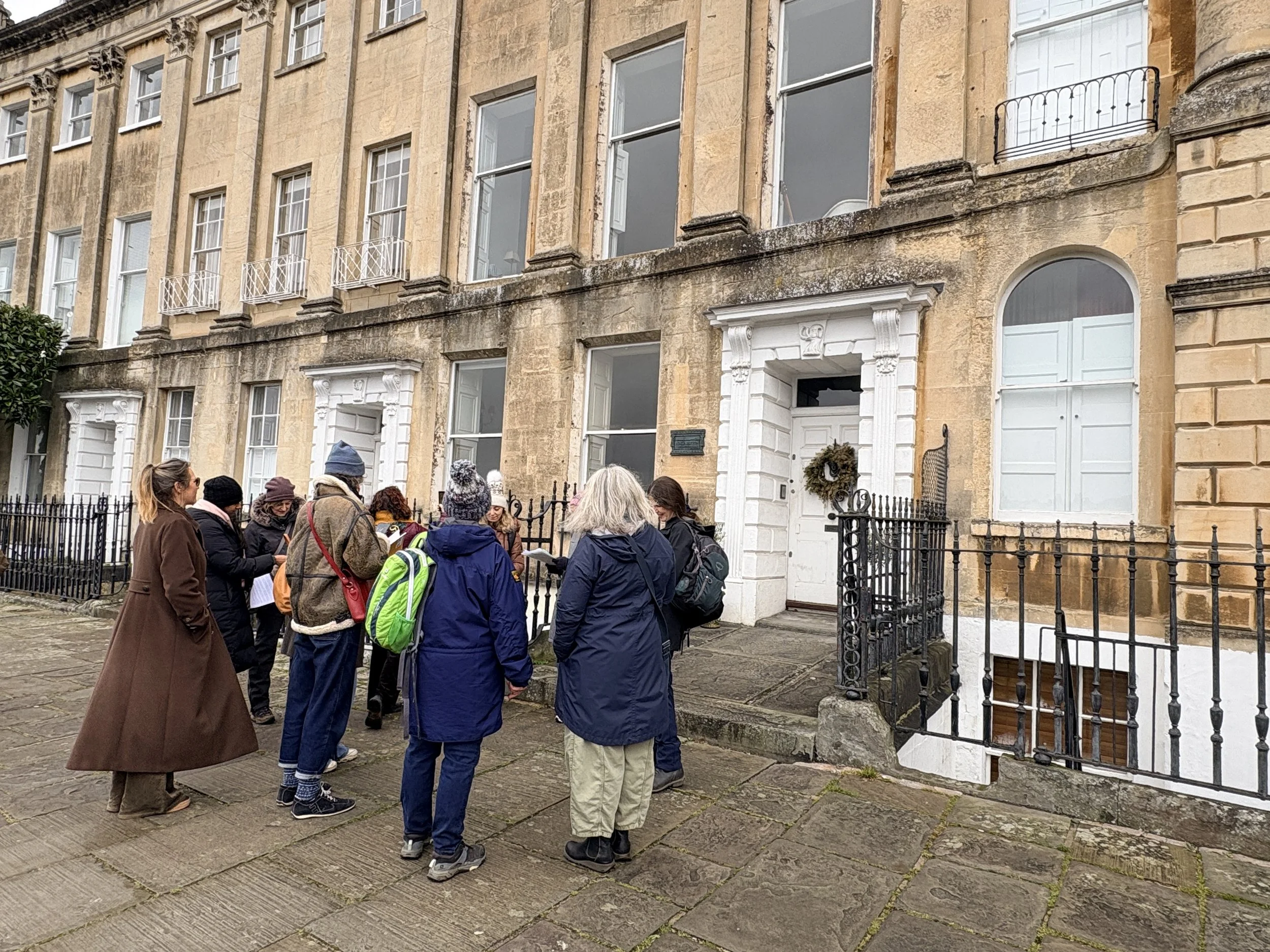
Turn left into Brock Street and walk to the Royal Crescent, stopping at no. 8, former home to gifted linguist, singer and musician, Ann Ford Thicknesse. The plaque at no.11 marks the night in 1772 when Eliza Linley secretly eloped from this house to Francewith playwright Richard Brinsley Sheridan. No. 16 is now the Royal Crescent Hotel and was formerly home to Elizabeth Montagu, 18th-century social reformer, literary critic, writer and co-founder of the Blue Stockings Society, and in the 19th-century to theBurdett-Coutts family. Youngest daughter Angela became Baroness Burdett-Coutts, one of the most dedicated and radical philanthropists of her day.
Continue to 22 Royal Crescent with the primrose yellow door: first painted this colour in the 1970s Amabel Wellesley-Colley who then fought legal action from the Bath Corporation and the Bath Trust to keep it yellow. Walk back along the Royal Crescent, turn right at the end to walk along The Gravel Walk. Turn right at the end to follow round Queen’s Parade, leading to Queen Square, home to Bath Royal Literary and Scientific Institution.
Walk along Old King Street, turn into John Street leading into Queen Street. Bluestocking and acclaimed novelist, diarist and playwright, Frances Burney stayed on Queen Street for some of her time in Bath.
Continue through the Arch and turn left into Upper Borough Walls. Turn right at the end into High Street. The Harvey building is the site where a photograph was taken in 1963 of Ruth Coard and her husband, Peter, recording detail at the rear of 24 High Street as part of their work to document buildings being demolished during the ‘Sack of Bath’, published in their book, ‘Vanishing Bath’.
The north wing of Bath Guildhall housed the Bath School of Art and Technical School, where Doris Hatt studied in the 1910s. She became a pioneer of British Modernism and an activist.
Continue to Bath Abbey, where King Edgar and Queen Ælfthryth were crowned in 973.She was the first consort of an English King known to have been crowned and anointed as Queen and became a political figure. Walk around Bath Abbey to come out in Orange Grove.
The Old Police Station was converted into a restaurant in 1998 (currently Browns) and the old prison cells are now the toilets. This is where suffragettes were detained, including, Mabel Capper who tried after she broke windows of the old Post Office on New Bond Street.
Continue to Grand Parade overlooking the river. There is a plaque in memory of Sinéad Williams, a canoeist who sadly died in Pulteney Weir in 1993 when it was swollen with rain.
Walk around the side of Victoria Art Gallery into Bridge Street to look up at the statue of Queen Victoria, where you will read the inscription “Erected in loyalty and love by the women of Bath”. The statue was funded by donations from local women.
Walk across Pulteney Bridge, named after Frances Pulteney, who inherited the 600-acre rural Bathwick estate in 1767, which was accessed by the Bathwick Ferry at that time.Frances and her husband, William, developed this spectacular bridge over the Avon and the spectacular Georgian New Town.
Continue into Laura Place, named after (Henrietta) Laura Pulteney, Frances’ daughter who became one of the richest heiresses in England. 2 Laura Place was home to “the most celebrated and influential woman of her time”, Georgiana Spencer, when she was ‘exiled’ out of London by her husband, the 5th Duke of Devonshire, for a time.
Walk along the right side of Great Pulteney Street. At no. 76, there is a plaque to Hannah More, a talented and influential poet, playwright and philanthropist, best known for her writings on abolition and women to join the anti-slavery movement. Continue along Great Pulteney Street to finish back at The Holburne Museum.
Amenities
Holburne Cafe, The Holburne Museum, Great Pulteney Street, Bathwick, BA2 4DB
Toilets - at the museum, and by Waitrose in the City Centre
Green Bird Cafe, 11 Margaret’s Buildings, Bath BA1 2LP
